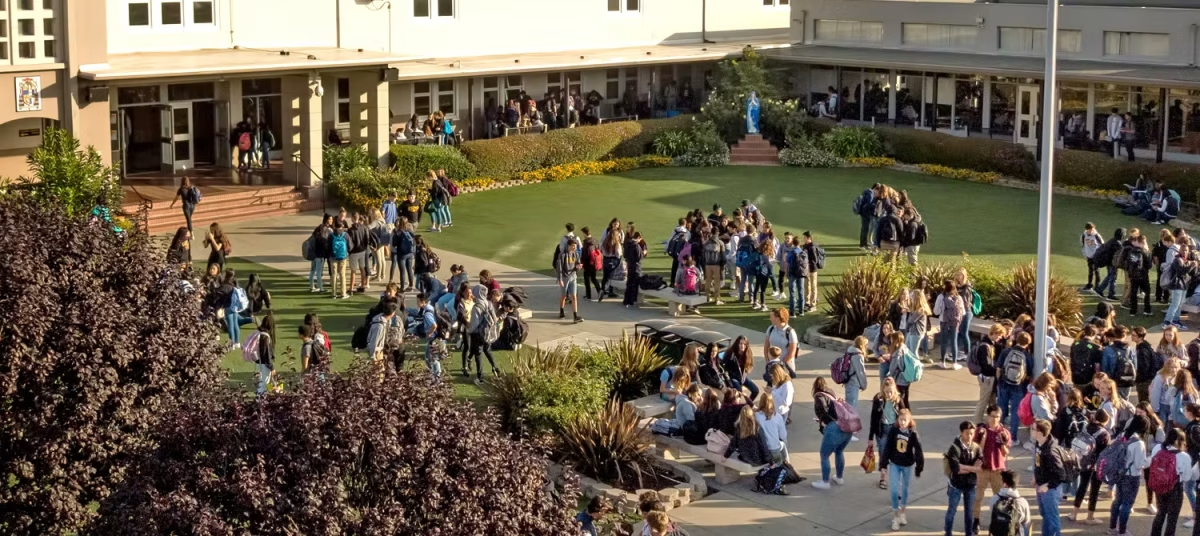
Jostling through hallways still buzzing from the three-day Martin Luther King Jr. weekend, the Bishop O’Dowd community packed into the Knauss Gym on January 22nd for the school’s annual Holocaust remembrance assembly. This year, however, the assembly carried a rare immediacy: Holocaust survivor Paul Schwarzbart sat in the front row alongside his wife, Sherry Schwarzbart.
As of early 2026, an estimated 30,000 Holocaust survivors remain alive in the United States, a number that continues to shrink each year. Accordingly, Associate Principal Mary Vanderpol reminded students and faculty of the urgency of bearing witness. “You’re here for your own learning,” she said, “but also for the learning of your children and grandchildren.”
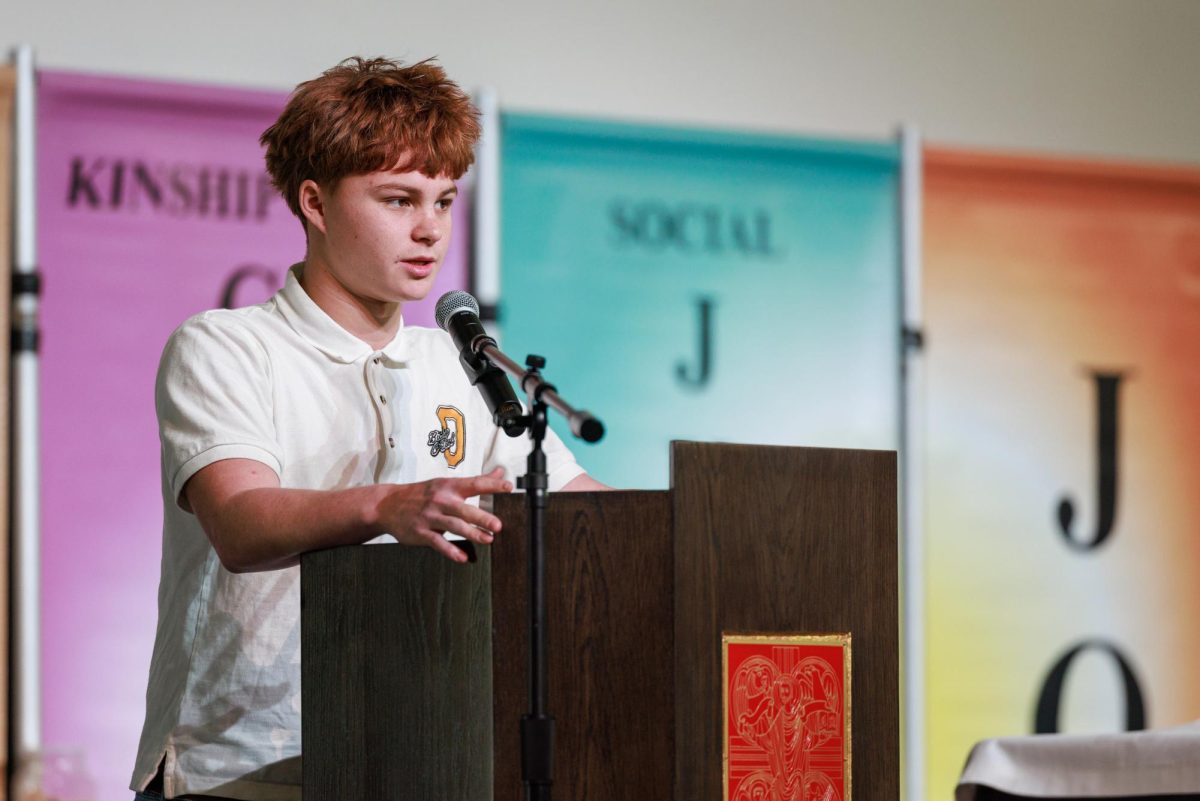
In their introduction, members of O’Dowd’s Jewish Student Union defined the Holocaust as “the genocide of Jewish, Romani, disabled, Black, homosexual, and other minority groups by the Nazi government during World War II.” Jewish Student Union president Owen Udkow ’26 proceeded to emphasize that the atrocity was not the work of a few individuals alone. “This tragedy was not solely caused by people in power,” he said, “but enabled by the silence and inaction of countless individuals.”
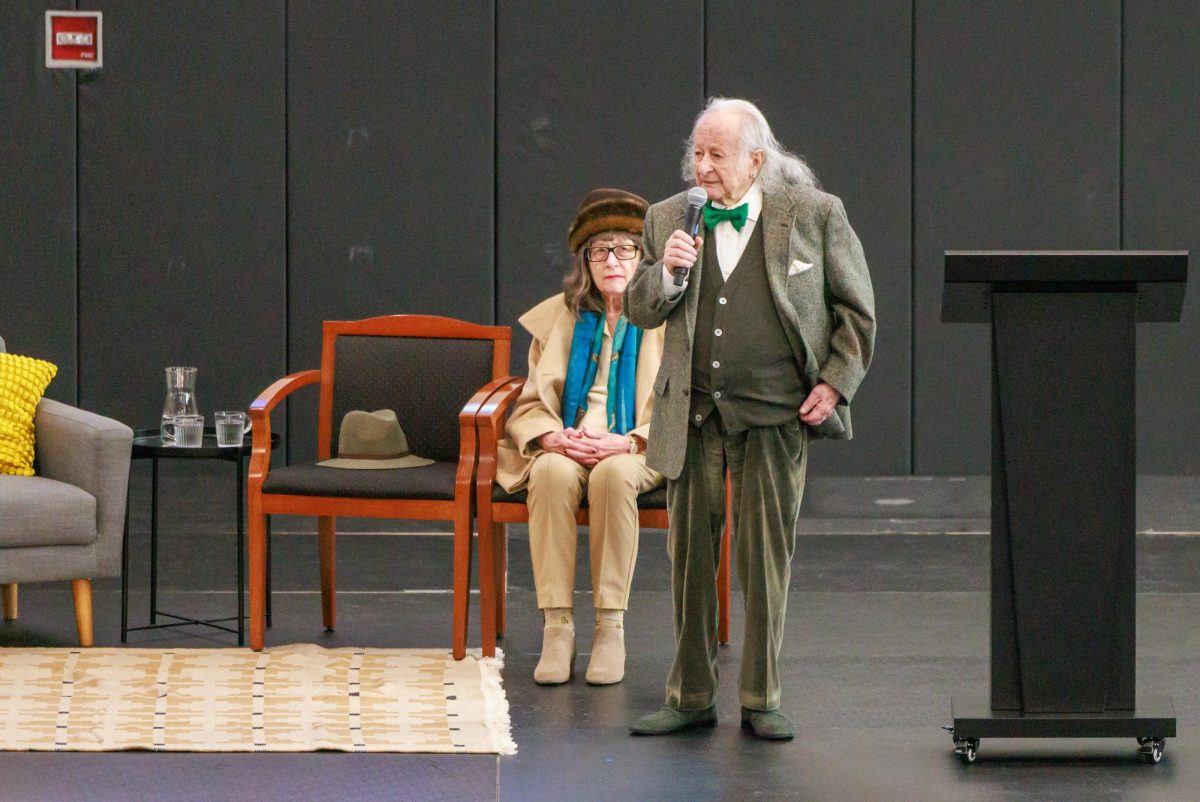
Dressed in a gray suit and green bow tie, Mr. Paul Schwarzbart, accompanied by his wife Ms. Sheryl Schwarzbart, ascended the steps to the stage. As Mr. Schwarzbart took the microphone in his right hand, the absent-minded tapping of shoes and hasty whispers to friends, characteristic of a gym packed with high school students, fell quiet, bringing a distinctive silence unusual for an O’Dowd assembly.
Born in Vienna in 1933, Mr. Schwarzbart was five years old when Nazi Germany annexed Austria. As violence intensified, his family fled to Belgium, but in 1940 Germany invaded there as well. His father was arrested for being Austrian.
“He told me he would be back that day or the next,” Mr. Schwarzbart recalled. “And in the meantime, I would be the man of the family and take good care of my mother.”
His father never returned. “They killed him in Buchenwald on February 18, 1945,” Mr. Schwarzbart said. “The camp was liberated two months later. He almost made it.”
Paul and his mother remained in Belgium under German occupation, forced to wear yellow stars and live among constant fear. In 1943, a young man approached his mother with a devastating question. “He asked whether she was interested in saving my life,” Mr. Schwarzbart said. “A question no mother should ever hear.” To do so, she had to give her son up.
At age 10, Paul boarded a train alone and was taken to a Catholic school, where he lived in hiding. He prayed, served as an altar boy, and learned to blend in. “At night I was Jewish,” he said. “During the day, I was a Catholic Cub Scout.” He received no letters from home and learned to lie to explain the silence. “I cried myself to sleep every night.”
One morning, gunfire woke him. American troops had arrived. At 11 years old, Paul walked across Belgium searching for his family. He spotted his mother from a block away. “We ran toward each other,” he said. “We screamed, we cried, we laughed.” She told him they would wait for his father together.
No one ever came back. Of his extended family, 66 were killed.
After the war, Paul and his mother immigrated to the United States. Years later, he learned that nearly 80 of the 124 boys at his Catholic school were Jewish children in hiding, many of whom survived and later built families of their own.
Near the end of his talk, Mr. Schwarzbart paused. “It’s scary what’s happening,” he said. “I thought I would never see stormtroopers in the streets again. But here they are.”
As if on cue, O’Dowd students and faculty rose in unison, applause cutting through the still silence of moments earlier, thundering through Knauss.
Mr. Schwarzbart’s ending message was simple, but urgent: “Never underestimate the power that you have as an individual to change the world.”