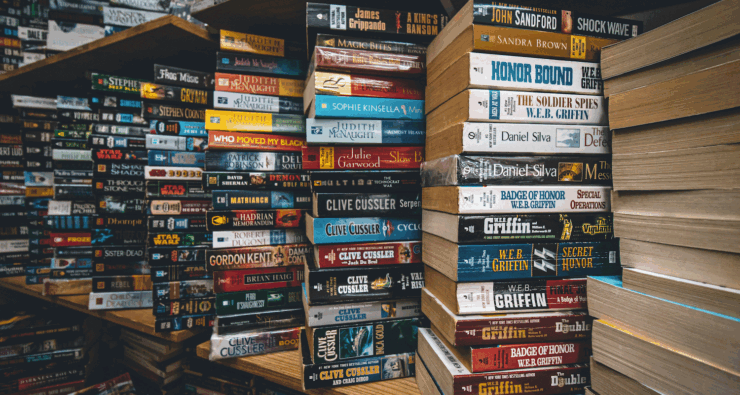
Recently ReaderLink, the biggest distributor of books in the U.S. announced they would stop producing mass market paperbacks, according to The Guardian this decision came after years and years of declining book sales. Reports from ReaderLink’s company states 131 million units were sold in 2004, going down to just 21 million in 2024, nearly an 84% decrease in sales.
Mass market paperbacks started in the 1930s originally as pocket books but their production increased greatly during World War II where they were officially made and distributed to soldiers in the “Armed Services Editions” or ASE programs. After the end of the war, they entered the American market and became the household standard for consuming all forms of long form literature.
Compared to trade-paperbacks and hardcovers, mass market paperbacks are cheaper to produce and come at much lower costs for consumers. These unique traits made them the go-to introductory book to buy for any new readers.
However in the past decade their place in the market has continually been threatened. The proliferation of Amazon’s mass market e-reader Kindle has shifted millions of dollars out of paperbacks and into their products. Beyond this with the rise of audio books in platforms like Amazon’s Audible, paperback reading has become less and less popular.
Why spend money on a physical book when you could get it at a cheaper price and have it instantly available on your own device?
Overall, many may see this as a logical and overall positive shift for the publishing market. With Readerlink and many others slowing down the production of mass market paperbacks, bookstores won’t be overburdened with books no one buys. Meaning they can shift their catalogs to higher quality prints like hardcovers that readers actually want, an easy win for the distributors, the sellers, and the readers alike.
But in reality, this shift is incredibly dangerous for the future of the publishing industry and far more importantly, a deep threat to authors.
Mass-market paperbacks have always been the cheapest form of publishing that companies could afford to risk on new rising authors. During a lecture at BYU famed sci-fi and fantasy author Brandon Sanderson discussed how these books were integral to his breakthrough. His novel Mistborn initially released as a trade-paperback by Tor Books, receiving moderate success but nothing longstanding. In response, Sanderson and his editor pushed for a redo of the cover art and a repackage as a mass market paperback, which launched the book’s sales by incredible margins.
Mass market paperbacks are an invaluable resource for publishers and authors, because they are cheap and low risk to produce.
But with ReaderLink pulling the plug and many retail stores doing the same, the market for new writers is shrinking.
Independent author and youtuber Daniel Greene discusses this very issue on his own channel. He states that, “Report after report has shown us that even the big five publishers and all their subsidiaries are becoming more and more dependent on whales,” They are looking at the biggest selling authors in their catalogues to finance them on taking risks with lesser known and intermediate writers. . . So there is still a ‘middle class of authors’ but with the slow decline of paperback, I am nervous for their future.”
Beyond this the control of the publishing market is becoming more and more centralized. In an article from Wordsrated.com, journalist Dimitrije Curcic analyzed several statistics around book publishing. Amazon’s Audible held around a 63.4% market share in the audiobook publishing category. And Amazon at large controls between 50-80% of all book distribution in the U.S.
This is even more concerning given Amazon over the past few years has been criticized on several occasions for the mistreatment of their writers. From using their catalogue of books to train AI systems, to taking larger and larger percentages of revenue from their authors.
Recently, Brandon Sanderson went toe to toe with Amazon as he attempted to leverage his own catalogue of books to get the company to raise the revenue for authors.
Likewise, over the last few years authors have had to fight more and more to secure their livelihoods against these large companies. Many of these endeavors have proved successful, like when the Writers Guild of America successfully lobbied for regulations against job cuts and AI writing in Hollywood
However, traditional authors and indie publishers have far less power and influence over the companies like Amazon that they are beholden to to make a living. All of this is a clear threat to not only independently published authors, but all writers and readers alike. Also, a call to be aware and knowledgeable about how you read and consume your favorite stories.
Bishop O’Dowd’s own English teacher, Mr. Blasser, discussed how a growing shift in the economy has resulted not only in damages to the publishing industry, but entertainment and consumers as a whole. “Over the last century, most major economic advancements have come from streamlining the consumer experience,” he said. “Life has become so convenient that we feel oppressed if we are inconvenienced. And pushing back against these companies requires us to be inconvenienced.”
Oftentimes, we see the major headlines and catastrophes and feel like we have no power. But our ability to bring about change comes from our everyday decisions. Decisions to be inconvenienced. So, next time you’re looking to try out that new book, maybe check out a local bookstore.