Governor of California Gavin Newsom recently passed a law standardizing phonetic learning for public schools in the state. Phonetics is the teaching method for reading where students are taught to construct and discern the meaning of words by sounding out the individual sounds or phonemes. But why after so many years are we changing how reading and writing is taught in schools?
According to The National Literacy Institute 54% of adults in America read at a sixth grade level, while nearly 64% of the country’s fourth graders do not even meet a competent reading proficiency. Several studies have shown a decline in overall reading since the last few years.
According to the National Education Association or NEA in the year 2022 only about 48.5% of adults reported reading at least one book for pleasure, compared to 52.7% five years earlier and 54.6% ten years earlier. Overall, fiction reading has reached its lowest rates ever.
Many educators and researchers have pointed to the abandoning of phonetics as the cause of the decline of reading in the U.S. Prior to the 1980’s, America primarily followed phonetics but due to many research studies and vocal educators, whole language learning was slowly adopted. This is a form of instruction where the direct meaning of a word is taught without the need to sound out the phonetic components.
In an interview Bishop O’Dowd’s own English teacher Ms. Oliver comments on why whole language as a system inherently inhibits the development of reading. “The most basic level of active reading is phonetics. Learning to discern the meaning of a word by its individual sounds and components is a core base skill for any reader.”
Essentially a reader that learns phonetically naturally is pushed to figure out what words mean on their own. They are pushed towards engaging and parsing out a text on their own merit. While a reader that learns with whole language only ever learns what the word means by association, without any of the sounds or tools. It is a system that naturally discourages individual active reading.
If a phonetic reader comes to a word they don’t know, they have the tools to guess at its meaning. A whole language learner lacks this entirely and is forced to rely on the teacher or others for aid. And given that that is the basis of the system when the reader goes on to more and more complex texts, they will naturally struggle. If they cannot guess or deduce the meaning of a single word alone, then they will inevitably struggle to understand the meaning of a metaphor, a complex prose, or even a whole text without aid.
This issue is only exacerbated in our current society where so much information is instantly available. We are long past the days where you must rely on a teacher to guide you to the meaning of a text. Now you can simply Google the answer, or even ask ChatGPT or Gemini to explain it. And with the advent of social media, there’s a constant demand for our entertainment to be instant, to be simple, and to be easily understood. We live in a world where reading passivity has become the norm.
“Reading is the most collaborative form of entertainment we’ve ever created. That is the core beauty of the art-form.” Ms. Oliver adds.
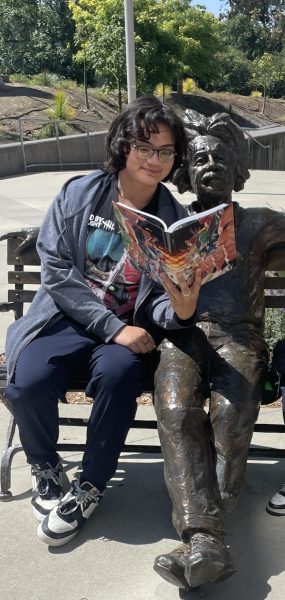
I agree wholly with Ms. Oliver; books don’t ask you to be a passive observer. They ask you to be a collaborator to enter the story alongside the author and bring your input to the work. You choose which words to emphasize while reading, you choose which prose to mull over, you get to choose what you picture in your head while you read.
And it’s such a detriment that we’re watching our society slowly turn away from this. That we’re watching such a beautiful art-form slowly become more and more forgotten. It’s something I believe we all need to take the time to combat. Not only by supporting the larger laws and policies, but also on an individual level. We have to be willing to turn off the tv, put down our phones, even close the AI and just open a book. We have to learn to be okay with not instantly knowing the answer with being confused and going on with the book anyways.
Because stories are an amazing thing and they deserve to be enjoyed and told long after their creator has gone.
As Carl Sagan, infamous cosmologist and TV host stated, “What an astonishing thing a book is. It’s a flat object made from a tree with flexible parts on which are imprinted lots of funny dark squiggles. But one glance at it and you’re inside the mind of another person, maybe somebody dead for thousands of years. Across the millennia, an author is speaking clearly and silently inside your head, directly to you. Writing is perhaps the greatest of human inventions, binding together people who never knew each other, citizens of distant epochs. Books break the shackles of time. A book is proof that humans are capable of working magic.”