For over six decades, the National Aeronautics and Space Administration (NASA) has stood as one of the greatest embodiments of American innovation, courage, and intellect. Through decades of exploration — from the Apollo missions to the Mars rovers and the James Webb Space Telescope — NASA has represented not just a government agency, but an idea: that curiosity and discovery are among humanity’s greatest virtues. Today, that legacy faces an existential crisis.
In early 2025, President Donald Trump’s administration announced a sweeping reorganization of federal spending that significantly impacted science and research. Among the agencies most affected was NASA, the nation’s flagship space and aeronautics organization. Reports now confirm that approximately 83% of NASA’s 15,094-person staff have been furloughed, leaving only a skeleton crew to manage ongoing missions. Even more alarming, Trump’s proposed 2026 budget calls for a 47% reduction in NASA’s annual funding, slashing its allocation from $24.8 billion to roughly $18.8 billion.
This move has sparked outrage among scientists, engineers, and educators—many viewing it not simply as a budgetary adjustment, but as the slow dismantling of a proud national institution.
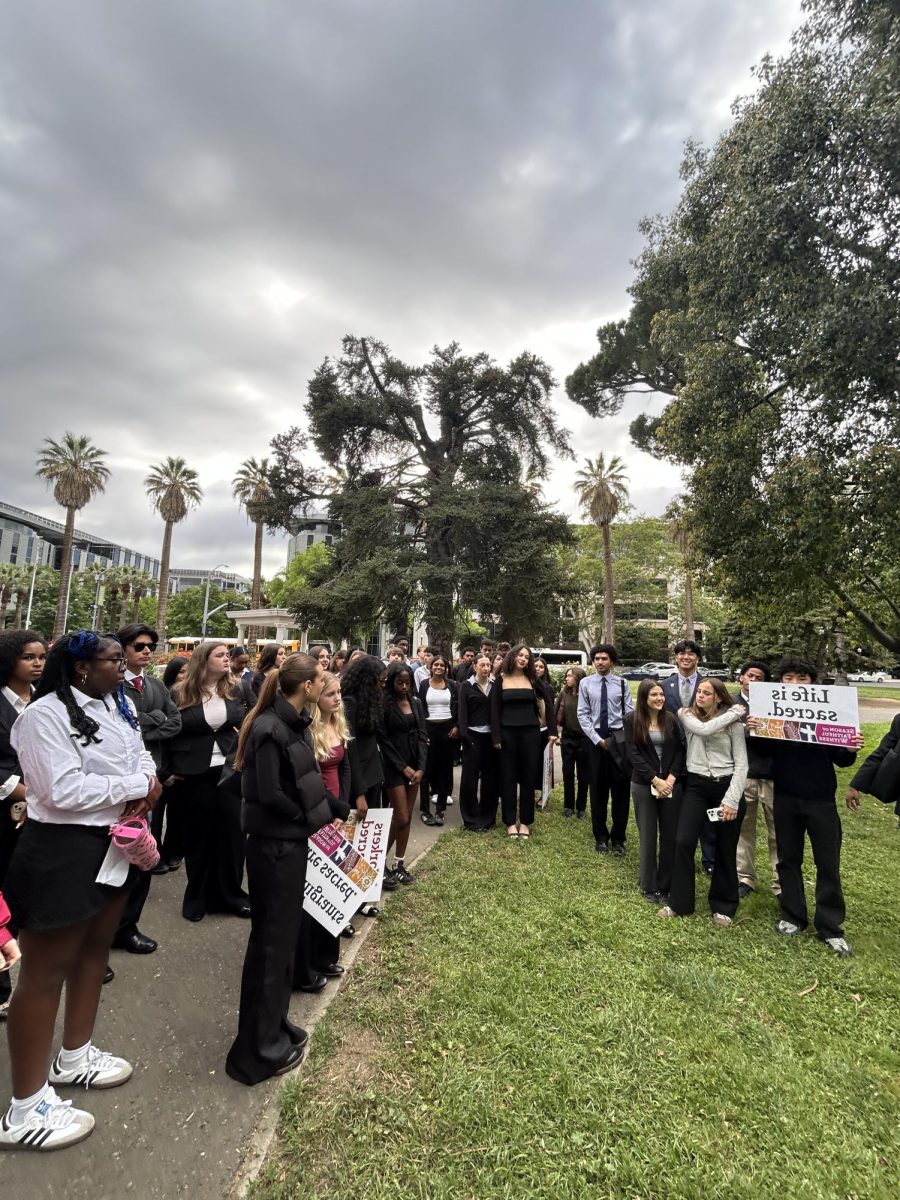
Bishop O’dowd Junior, Luke Whiton 27′, respond to concerns about NASA’s funding with a personal anecdote about what these cuts mean to his education: “In APES (Advanced Placement Environmental Studies) class today, there was a website that we needed to use to study for a test. And it was a NASA website, but we couldn’t, because they cut funding…So I think it [NASA and other National Scientific Organizations] is important.”
A Legacy Rooted in Republican Vision
Ironically, NASA’s very existence owes much to Republican leadership. In 1958, under President Dwight D. Eisenhower, NASA was signed into existence at the height of the Cold War, symbolizing American technological might and aspiration in the space race. The same spirit of innovation also gave rise to other essential scientific agencies like the National Oceanic and Atmospheric Administration (NOAA) and the Environmental Protection Agency (EPA)—both formed or expanded through bipartisan efforts, and both, like NASA, now find themselves in precarious positions due to deep proposed funding cuts.
These agencies were born from a sense of vision—recognizing that the progress of science and technology determines the progress of society itself. Each brought countless innovations that advanced not just American pride, but global well-being: weather forecasting, environmental protection, satellite communication, climate research, and medical spinoffs from space technology.
To see those institutions threatened today, many argue, is to witness the erosion of that legacy of optimism.

What’s at Stake…
NASA’s influence extends far beyond rockets and astronauts. Its discoveries and technologies have led to thousands of spinoffs that shape daily life — from GPS navigation and water purification systems to memory foam, CAT scans, and climate monitoring satellites. All things the average American uses in their daily life. The agency also plays a critical role in education, inspiring new generations to pursue science, engineering, and mathematics.
“To cut finding for science, dude? Like, what? I think it’s really stupid. The development of science is what, like, pioneers everything we have here. And you need chemical engineers to create new things and you need inventors to engineer new things. And NASA, even though is directly towards space, it’s not the only thing they do. […] Cutting funding is… not the best idea.” Says Logan Asport ’27 in response to NASA’s role in modern American Society.
A drastic cut of nearly half its budget will mean more than fewer space missions; it could trigger the shutdown of entire research centers, delay or cancel deep-space programs, halt climate observation projects, and force thousands of layoffs in allied industries that depend on NASA contracts. With over 80% of its workforce furloughed, this is not a distant concern — it is already happening.
Moreover, such a massive rollback threatens America’s leadership in global space exploration. While NASA is being stripped down, countries like China and India are accelerating their investments in cutting-edge space technology. Creating a wide gap between foreign and American technological and societal advancements-a rift that will take generations to close. The Chinese National Space Administration (CNSA) is establishing lunar bases, while India’s ISRO is expanding its planetary missions. Without sufficient funding, NASA risks falling behind, forfeiting its role as the world’s foremost space pioneer.

Political and Cultural Ramifications
The proposed “dismantralization” of NASA, as some critics describe it, raises profound questions about how the United States views science and its purpose in society. Cuts of this magnitude are not just financial—they reflect priorities. When funding for a space agency is slashed while other discretionary areas grow, it reveals how leadership assesses the value of knowledge, research, and exploration.
The call for the removal of NASA’s chief administrator, whose leadership has reportedly clashed with recent White House directives, further underscores the depth of administrative upheaval. This shake-up could leave the agency without clear vision or stability at a time when coordination across departments is essential for projects like Artemis—the program aiming to return humans to the Moon and eventually to Mars.
Astrophysicist Neil deGrasse Tyson once said, “Science is the foundation of our health, our wealth, our security.” That quote resonates powerfully today. Tyson’s words remind us that scientific investment is never an expense; it is the bedrock of national prosperity. Every scientific discovery becomes a seed for future industries, jobs, and solutions to global problems. To reduce science to a political talking point or budgetary casualty is to mortgage the future for short-term optics.

Consequences Beyond NASA
The broader effects ripple outward. The NOAA, responsible for climate and weather data critical to national defense, agriculture, and disaster preparedness, faces similar uncertainty. The EPA, a guardian of environmental and public health, is experiencing comparable reorganizations that reduce oversight and research capabilities. Together, these agencies anchor the federal scientific landscape. Their weakening means diminished ability to respond to environmental crises, weakened forecasting of severe weather events, and less understanding of the planet’s changing climate.
Taken collectively, these cuts signal not just a budgetary reshuffle but a cultural shift — one that diminishes fact-based policymaking and replaces it with ideological positioning.
For America, the question is not whether we can afford to fund science. The question is whether we can afford not to. NASA has long symbolized the best of what this nation can achieve when imagination meets commitment. To see its resources gutted and its workforce sidelined is to risk extinguishing that symbol — one that once united Americans beyond party lines and inspired the world.
The dismantling of NASA is more than an administrative decision; it represents a philosophical retreat from the frontier spirit that made the United States a world leader in science and technology. If innovation is indeed the driving force behind advancing societies, then undermining it is akin to halting progress itself.
What remains to be seen is whether the American public, scientific community, and Congress will rally to defend not just NASA, but the very idea it represents — that a nation committed to exploration will always rise higher than one content to look down.