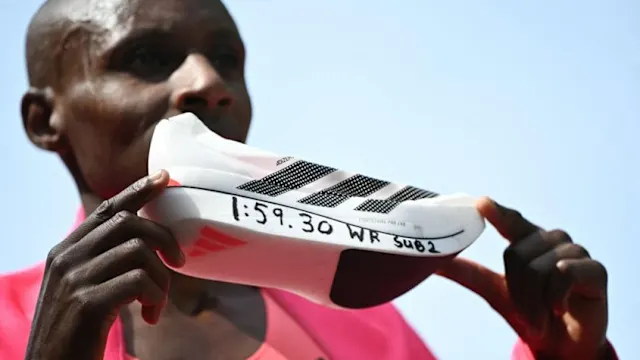
On April 26, a world record was broken at the TCS London Marathon. Sabastian Sawe, a Kenyan long-distance runner ran a marathon in 1 hour 59 minute and 30 second, the first ever sub two hour marathon. Up until now people assumed running a sub two mile marathon was impossible. However Sabastain Sawe did not run that race alone, he had some help from his shoes.
Sanstain Sawe ran the marathon in the Adizero Adios Pro Evo3, shoes specifically designed for marathon runners. The shoes weigh an average of 97 grams which is 3.4 ounces (thats about the weight of a deck of cards) and the shoes conatina a carbon fiber u-shaped rim. Lighter shoes have a big effect on long distance running. Some brands are even injecting the sols of shoes with gases like nitrogen to make them even lighter.
But the real advantage comes from more just weight. According to researchers, modern “super shoes” are designed to return energy back to the runner with each step. The combination of lightweight foam and stiff carbon plates help reduce the amount of energy lost when the foot hits the ground, essentially giving runners a small boost forward every stride. Over the course of 26.2 miles (a marathon), even a tiny improvement in efficiency can make a huge difference in finishing time.
This raises an important question in the running world: how much of this record was human ability, and how much was technology? Sebastian Taylor, a senior cross country runner at Bishop O’Dowd High School, has experienced this technology firsthand. “Yes, I have run in super shoes, and they have an immediate tangible impact on your race,” he said. “When I wear them, I feel bouncier and spend less energy.” Despite this advantage, Taylor believes the athlete still plays the biggest role, explaining that “training methods are becoming more optimized, allowing runners to focus on their strengths and improve their weaknesses.” He added that super shoes are “part of the sport evolving,” while also noting that past athletes who lacked this technology should still be recognized for their achievements. Some critics argue that these shoes give them an unfair advantage, comparing them to performance-enhancing equipment. Some nike and addias model running shoes have even been banned from races because of this. Others believed they are simply the next step in the natural evolution of sports, similar to improvement in track surfaces or training methods.
Despite the controversy, Sawe’s achivement is being celebrated worldwide. Breaking the two-hour barrier was once considered one of the last great limits in endurance sports. Whether it was pure athleticism, cutting-edge technology, or a combination of both, Sawe’s run has changed what people believe is possible.